How It Works

Football is uncertain. The uncertainty can still be measured.

MyFootballLab combines probability, team strength, league behavior and weekly updates to turn football uncertainty into a clearer analytical view.

01 · Uncertainty

Football is random, but not completely random.

A red card, a missed penalty, a deflection or one moment of brilliance can change a match. That uncertainty is part of football — but random does not mean impossible to analyze.

Patterns still appear across thousands of matches. By studying those patterns with statistics and probability, MyFootballLab estimates what is more likely to happen without pretending the game is deterministic.
02 · Probability

We build probability, not guesswork.

The model combines team strength, match context and league-specific behavior to create a structured view of each fixture.

The result is not a promise about one exact outcome. It is a probability-based view of the different outcomes that remain possible.

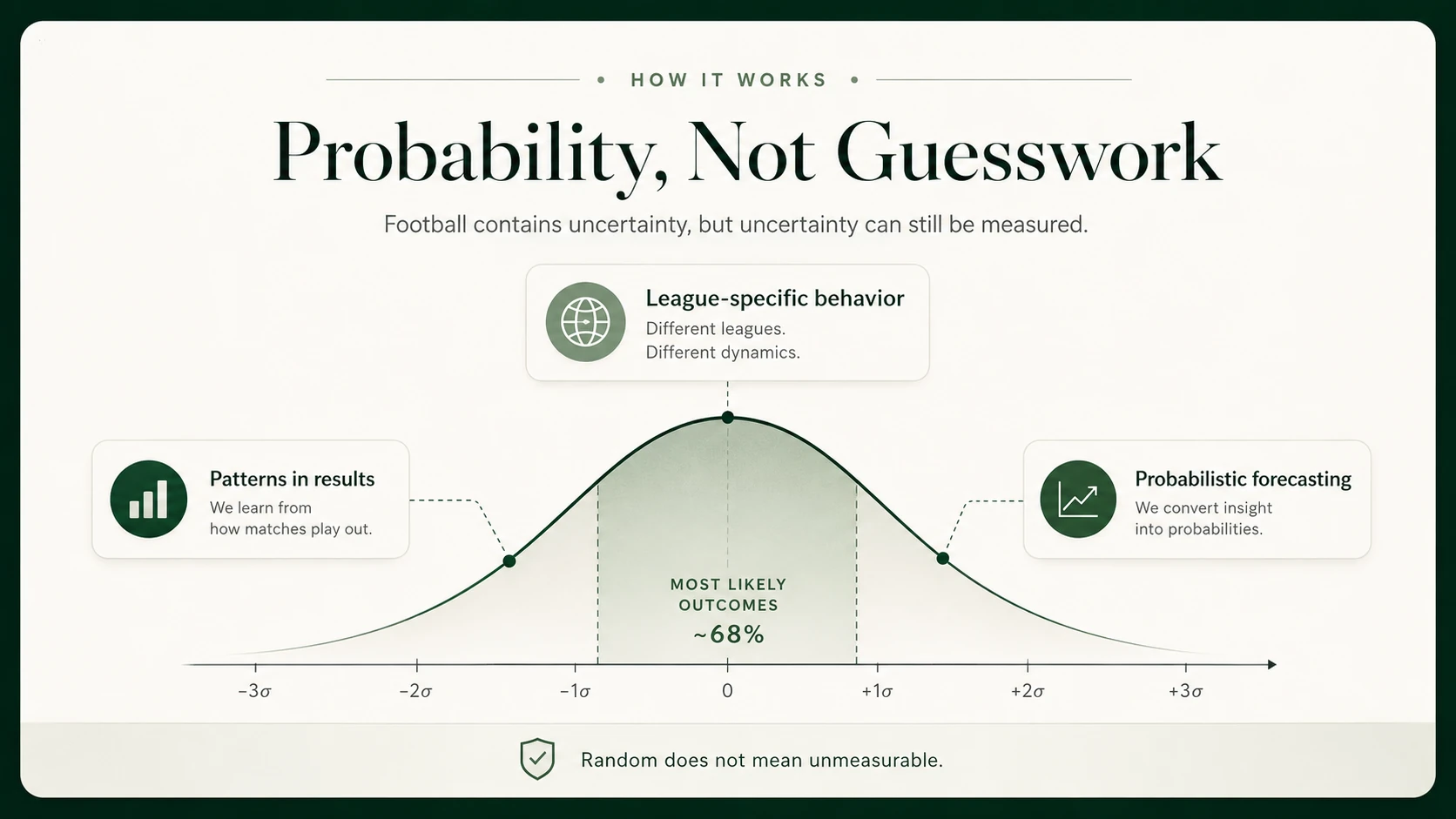
Probability bell curve explaining how uncertainty can be measured
The bell curve is a simple visual explanation of probability and uncertainty — not a claim that every football variable follows a normal distribution.

03 · League rhythm

Every league has its own rhythm.

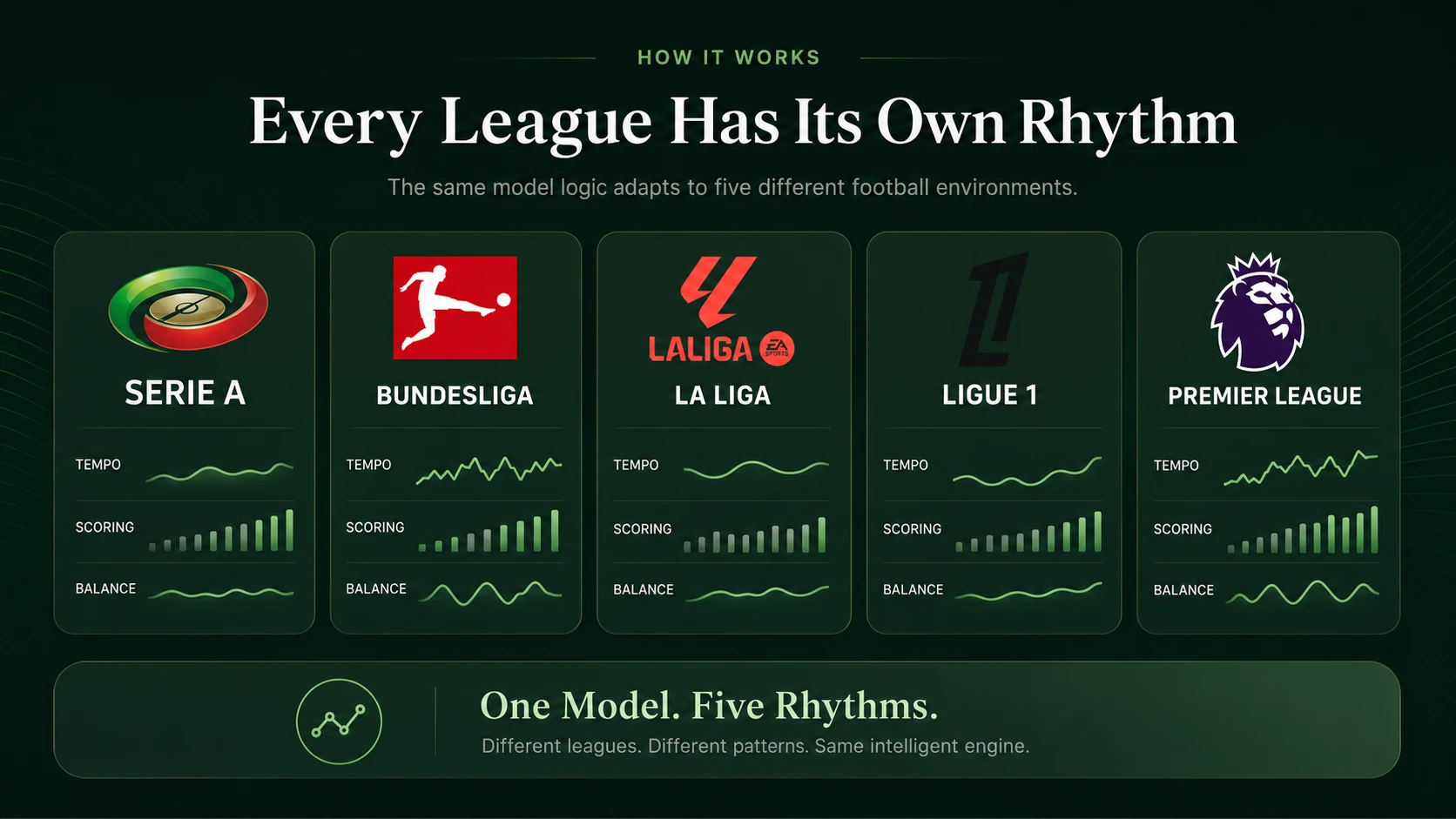
The Premier League does not behave exactly like La Liga. Serie A, Bundesliga and Ligue 1 also have their own scoring tendencies, competitive balance and seasonal dynamics.

MyFootballLab keeps that league context visible instead of treating every competition as if it behaves the same way. The goal is a more realistic interpretation of teams and fixtures inside their own football environment.

Five league rhythm infographic for Serie A, Bundesliga, La Liga, Ligue 1 and Premier League

04 · Team strength

Every team has a measurable competitive profile.

Each club enters the season with a different level of strength. MyFootballLab studies that profile through approved preseason information, historical context, league behavior and performance signals.

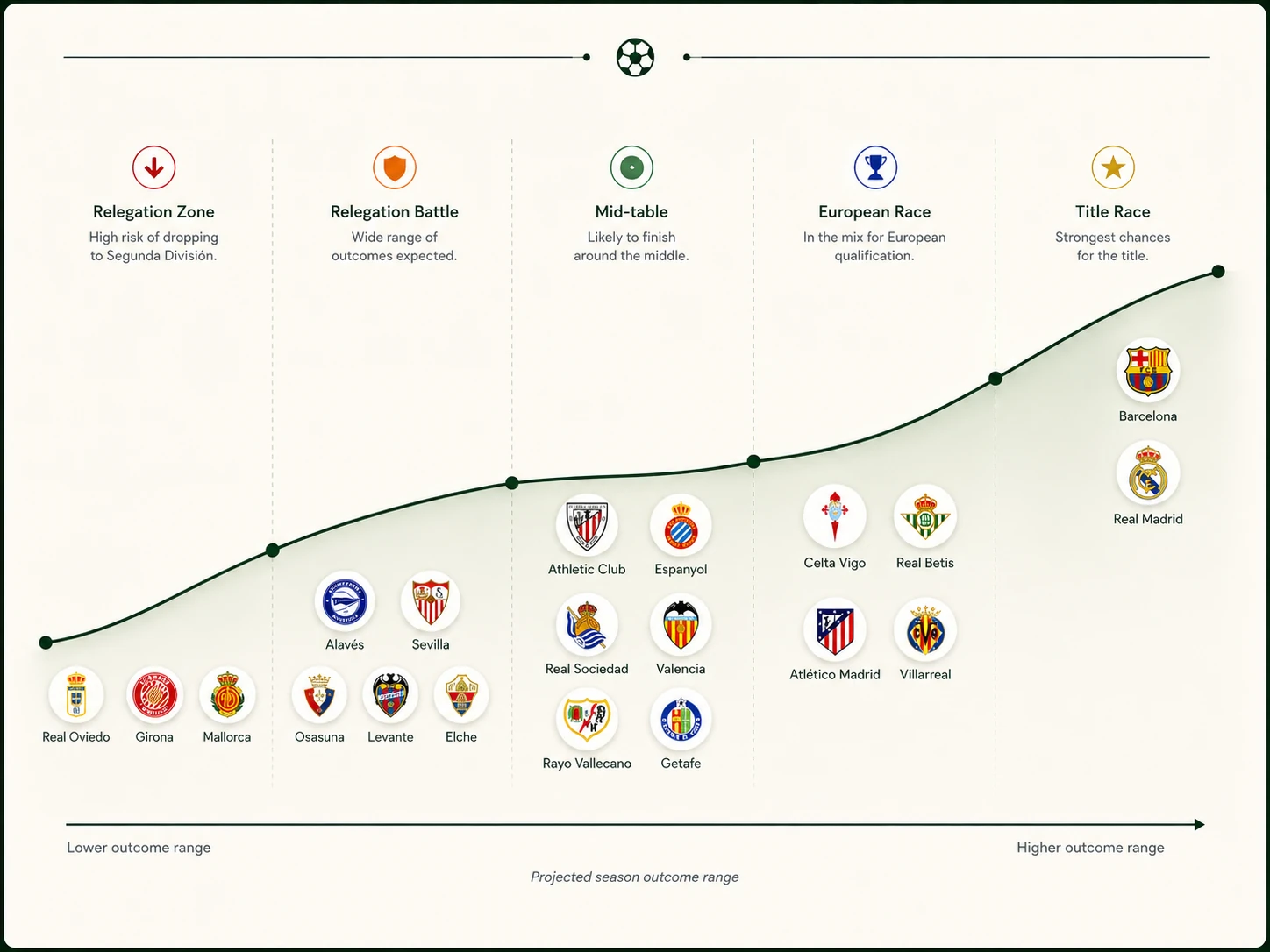
That produces a structured seasonal view of how competitive a team is expected to be. The outcome-zone graphic below illustrates the idea: teams can be viewed across ranges such as a relegation battle, mid-table, European qualification and a title race instead of being reduced to one fixed label.

Illustrative La Liga team outcome zones ranging from relegation risk to title race
Illustrative outcome-zone view. Club placement is used to explain the projection concept rather than present a live forecast on this page.

05 · Weekly learning

The model updates as the season reveals new information.

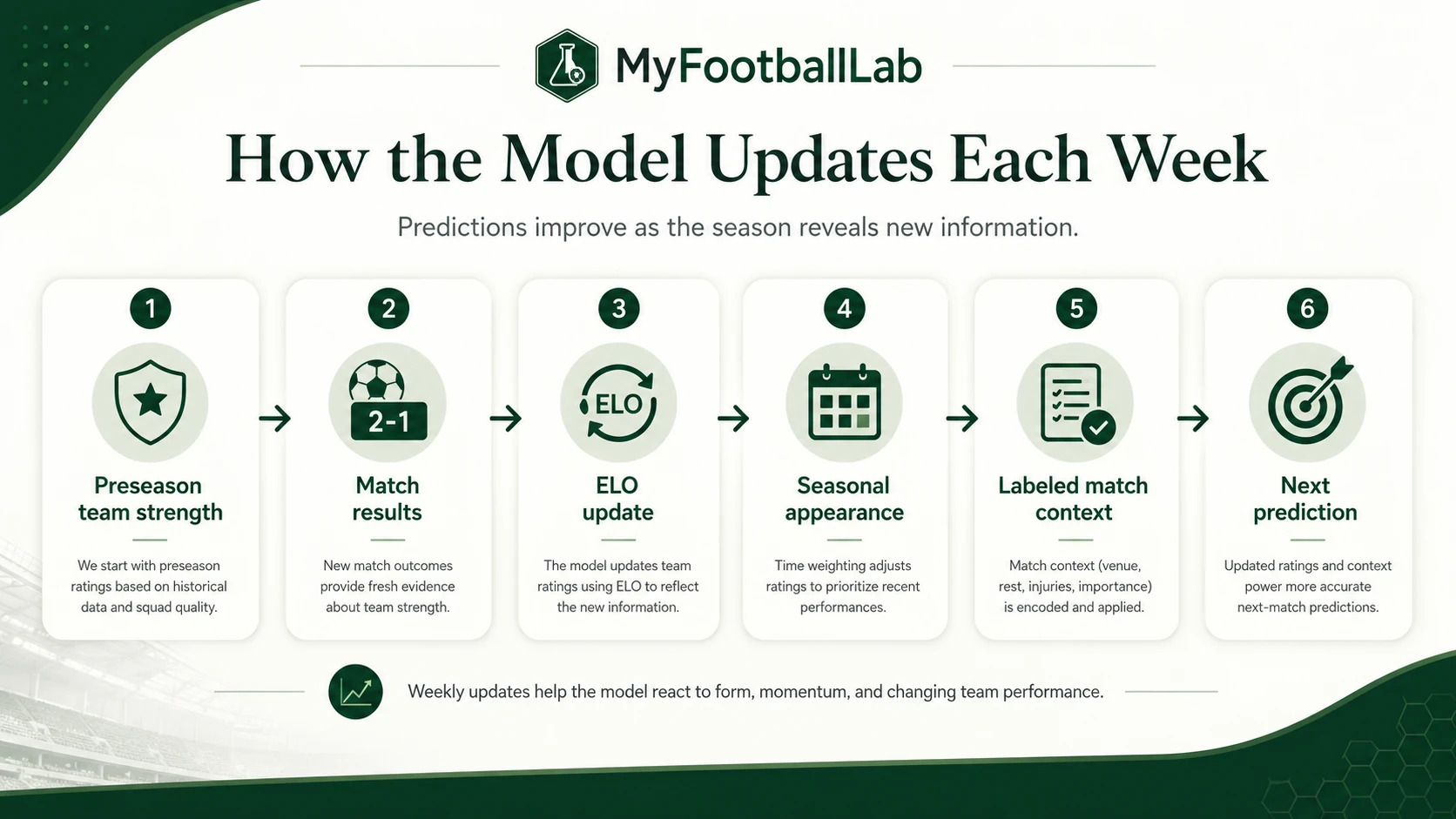
Football changes every week, so the model does too. As official results are added, team ELO ratings and seasonal performance signals are updated before the next set of predictions is prepared.

This allows the system to react to changing team performance while keeping the timeline disciplined: new information can influence future forecasts, but it does not rewrite predictions that were already made.

MyFootballLab weekly model update flow from preseason strength to the next prediction

06 · Consistent context

Labeling helps the system compare similar football situations.

Matches and team situations are organized with consistent contextual labels. That extra structure helps comparable situations stay comparable and supports clearer model evaluation across different match types and league conditions.

The principle

Predictions are probabilities, not promises.

No serious football model can predict every match correctly. MyFootballLab aims for something more useful: a disciplined statistical improvement in how matches, teams and season outcomes are understood.

The objective is not certainty. It is a better-informed view of uncertainty.

See it in practice

Move from methodology to live football intelligence.

Explore the match, league and season views built from the same probability-first approach.